Insights | September, 2026
How to Improve Digital Product Performance Through Data and User Feedback
BrandubeExplore how analytics, user feedback, and behavioral insights can reveal opportunities to improve usability, performance, engagement, and long-term product value.

Table of Content
Overview Introduction Define What Product Performance Means Collect the Right Product Data Understand User Behavior Use User Feedback to Find Friction Identify and Prioritize Performance Issues Improve the User Experience Measure the Impact of Product Improvements Build a Continuous Optimization Process Common Product Optimization Mistakes to Avoid Conclusion Frequently Asked QuestionsOverview
Digital product performance is more than how quickly a website or application loads. A successful digital product needs to perform well across usability, reliability, responsiveness, engagement, and the ability to help users accomplish meaningful goals.
Analytics and user feedback provide two important sources of information for understanding how a product performs in the real world. Analytics can reveal what users are doing, while direct feedback can help explain why they are experiencing problems or looking for something different.
When these insights are combined, product teams can identify friction, understand user needs, prioritize improvements, and continuously refine the digital experience.
Introduction
Digital products rarely remain perfect after launch. New users bring different behaviors, traffic patterns change, features are added, datasets grow, and business requirements evolve.
Even products that perform well during initial testing can develop new problems as real usage increases. A page may become slower, a workflow may become confusing, or an important feature may no longer match how users expect to work.
This is why product optimization should be treated as an ongoing process. Rather than making decisions based only on assumptions, teams can use data and feedback to understand what is actually happening and determine where improvements can create the greatest value.
Define What Product Performance Means
Before improving a digital product, it is important to define what performance means for that specific product. Different products have different goals, users, workflows, and success criteria.
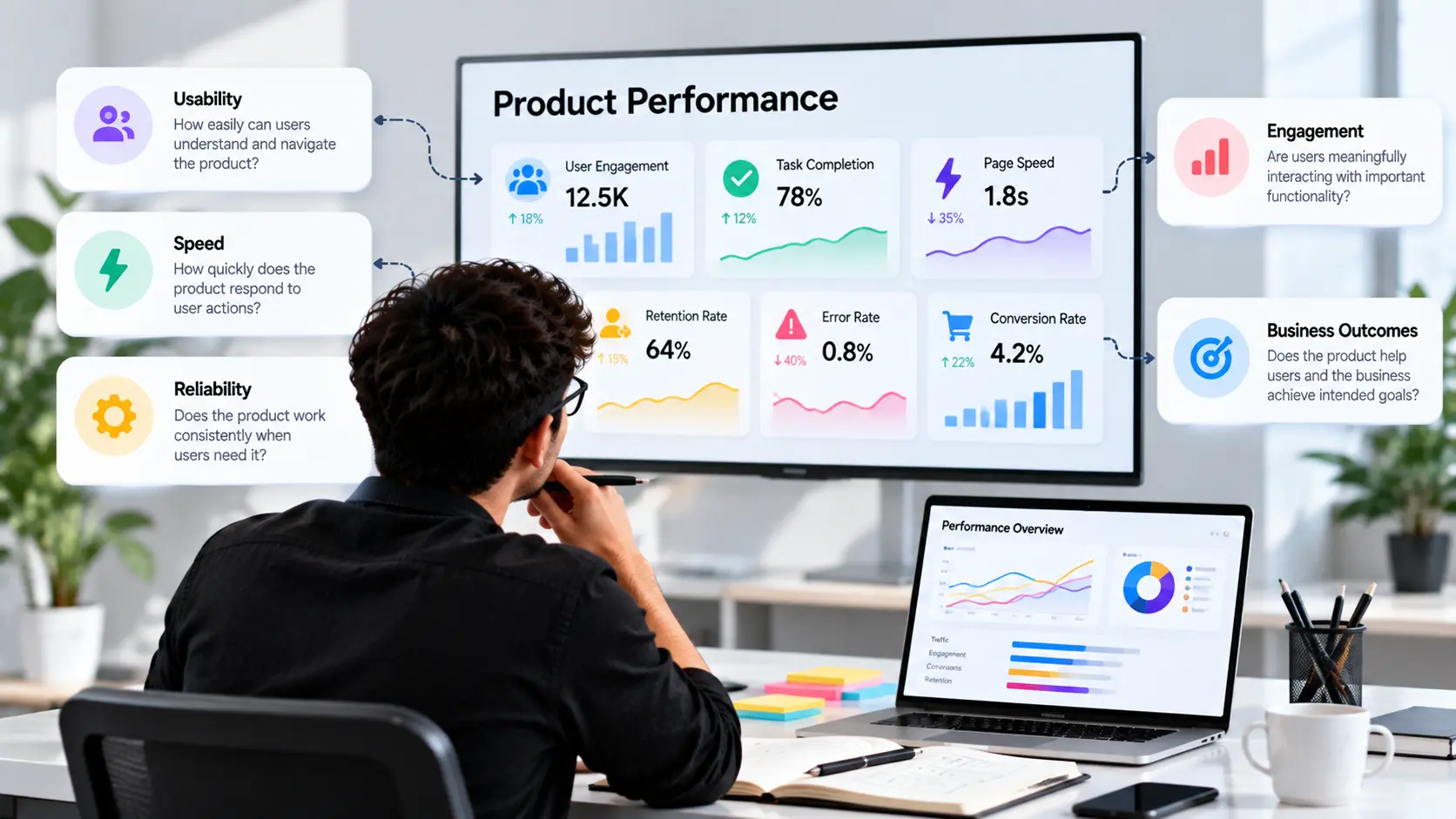
For a SaaS platform, performance may involve successful task completion, retention, responsiveness, and system reliability. For an e-commerce experience, it may include product discovery, checkout completion, page speed, and transaction reliability.
For a business application, performance may be closely connected to productivity and the time required to complete important workflows.
- Usability: How easily can users understand and navigate the product?
- Speed: How quickly does the product respond to user actions?
- Reliability: Does the product work consistently when users need it?
- Engagement: Are users meaningfully interacting with important functionality?
- Business outcomes: Does the product help users and the business achieve intended goals?
Collect the Right Product Data
Effective product optimization starts with useful information. The goal is not to collect every possible metric, but to identify data that helps explain product performance and user behavior.
Depending on the product, useful data may include page views, feature usage, conversion events, session behavior, task completion, errors, loading times, retention, and other product-specific metrics.
Data should be connected to meaningful product questions. Instead of simply asking how many users visited a page, teams might ask whether users were able to complete the intended action and where they encountered friction.

- Define important events: Identify actions that represent meaningful product usage.
- Track key workflows: Measure how users move through important journeys.
- Monitor technical performance: Track loading times, errors, failed requests, and reliability.
- Measure engagement: Understand which features users return to and use regularly.
- Connect metrics to goals: Focus on information that supports actual product decisions.
Understand User Behavior
Analytics can reveal patterns that are difficult to identify through observation alone. By examining user behavior, teams can discover where users spend time, where they move next, and where they stop progressing.
Behavioral analysis can be especially useful when reviewing important user journeys. For example, if many users abandon a process at the same stage, the team can investigate whether that stage contains unnecessary complexity, unclear information, technical problems, or another source of friction.
Patterns should be interpreted carefully. A metric can indicate that something is happening without explaining the underlying reason. That is where user feedback and qualitative research become valuable.
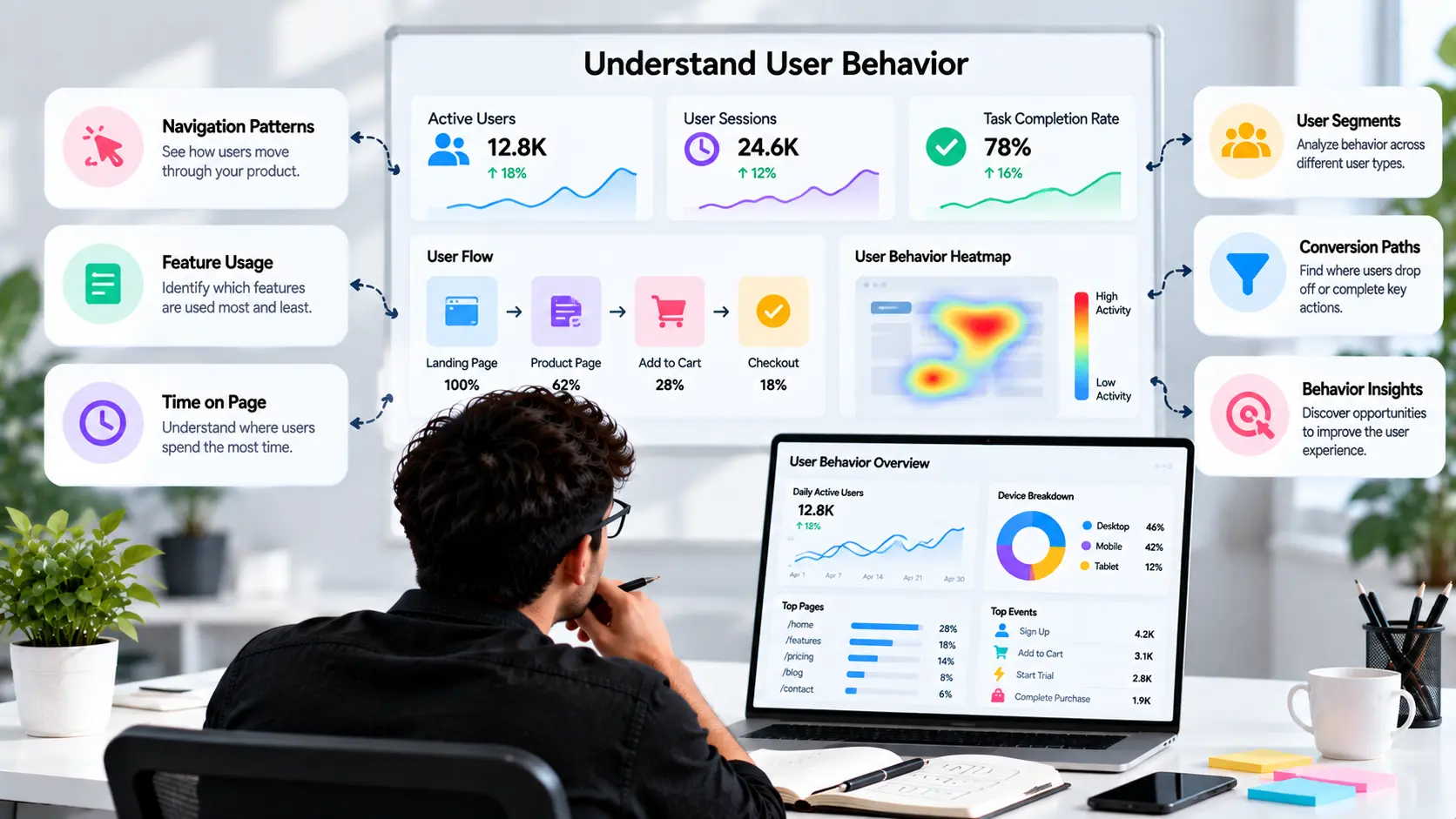
- Identify drop-off points: Find where users stop progressing through important journeys.
- Review feature usage: Understand which features receive meaningful engagement.
- Compare user journeys: Identify differences between successful and unsuccessful experiences.
- Observe recurring behavior: Look for patterns that appear across multiple users or sessions.
- Investigate anomalies: Examine unusual changes in behavior instead of immediately assuming the cause.
Use User Feedback to Find Friction
User feedback provides context that analytics alone cannot always provide. Customers can describe what feels confusing, difficult, slow, unnecessary, or missing from the experience.
Feedback can come from many sources, including support conversations, surveys, interviews, reviews, usability testing, feature requests, and direct communication with customers.
The most useful approach is to look for recurring patterns rather than reacting to every individual request. When similar problems appear across multiple users, they may indicate an opportunity for a broader product improvement.
- Collect feedback consistently: Create reliable ways for users to share problems and suggestions.
- Group recurring issues: Look for common themes across different conversations.
- Connect feedback with data: Use behavioral evidence to understand the scale of an issue.
- Validate assumptions: Test whether a proposed improvement addresses the actual problem.
- Close the feedback loop: Communicate improvements and continue learning from users.
Identify and Prioritize Performance Issues
Not every product issue requires immediate action. Teams need a practical way to determine which improvements should be addressed first.
Prioritization can consider user impact, business importance, technical severity, frequency, development effort, and the potential value of the improvement.
A small usability problem affecting thousands of users may deserve more attention than a technically complex issue affecting only a small number of people. Similarly, a security or reliability problem may require immediate attention even if it affects relatively few users.
- User impact: How significantly does the issue affect the user experience?
- Frequency: How often does the problem occur?
- Business impact: Does the issue affect important product or business outcomes?
- Technical risk: Could delaying the issue create larger technical problems?
- Effort: How much time and development work is required to address it?
Improve the User Experience
Performance improvements are not limited to technical optimization. The way a product communicates, guides, and responds to users can have an equally important effect on the overall experience.
Data may reveal that users are struggling with a particular workflow, while feedback may explain that the interface is unclear. The solution could involve changing the information architecture, simplifying the interface, improving content, reducing steps, or redesigning an interaction.
UX improvements should be connected to measurable product goals wherever possible. This makes it easier to understand whether a design change actually improved the experience.
- Simplify workflows: Remove unnecessary steps from important user journeys.
- Improve navigation: Make important features easier to discover.
- Clarify content: Help users understand what actions and information mean.
- Improve feedback: Clearly communicate progress, success, and errors.
- Test changes: Validate important UX improvements with real users where appropriate.
Measure the Impact of Product Improvements
Making a change is only one part of product optimization. Teams should also determine whether the change produced the intended result.
Before implementing a significant improvement, identify the outcome you expect to change. This could be a reduction in errors, faster task completion, increased feature adoption, improved conversion, or better user satisfaction.
After the change is released, compare relevant data and feedback. Not every improvement will produce an immediate or dramatic change, but measurement can provide evidence for future product decisions.
- Define the expected outcome: Decide what should improve as a result of the change.
- Measure before and after: Compare relevant product metrics over time.
- Review qualitative feedback: Understand how users perceive the updated experience.
- Watch for unintended effects: Make sure improvements do not create new problems elsewhere.
- Document learnings: Use results to inform future product decisions.
Build a Continuous Optimization Process
Product performance improves more consistently when optimization becomes part of the normal development process rather than an occasional project.
A continuous process can combine analytics, user feedback, technical monitoring, product strategy, UX research, and development planning.
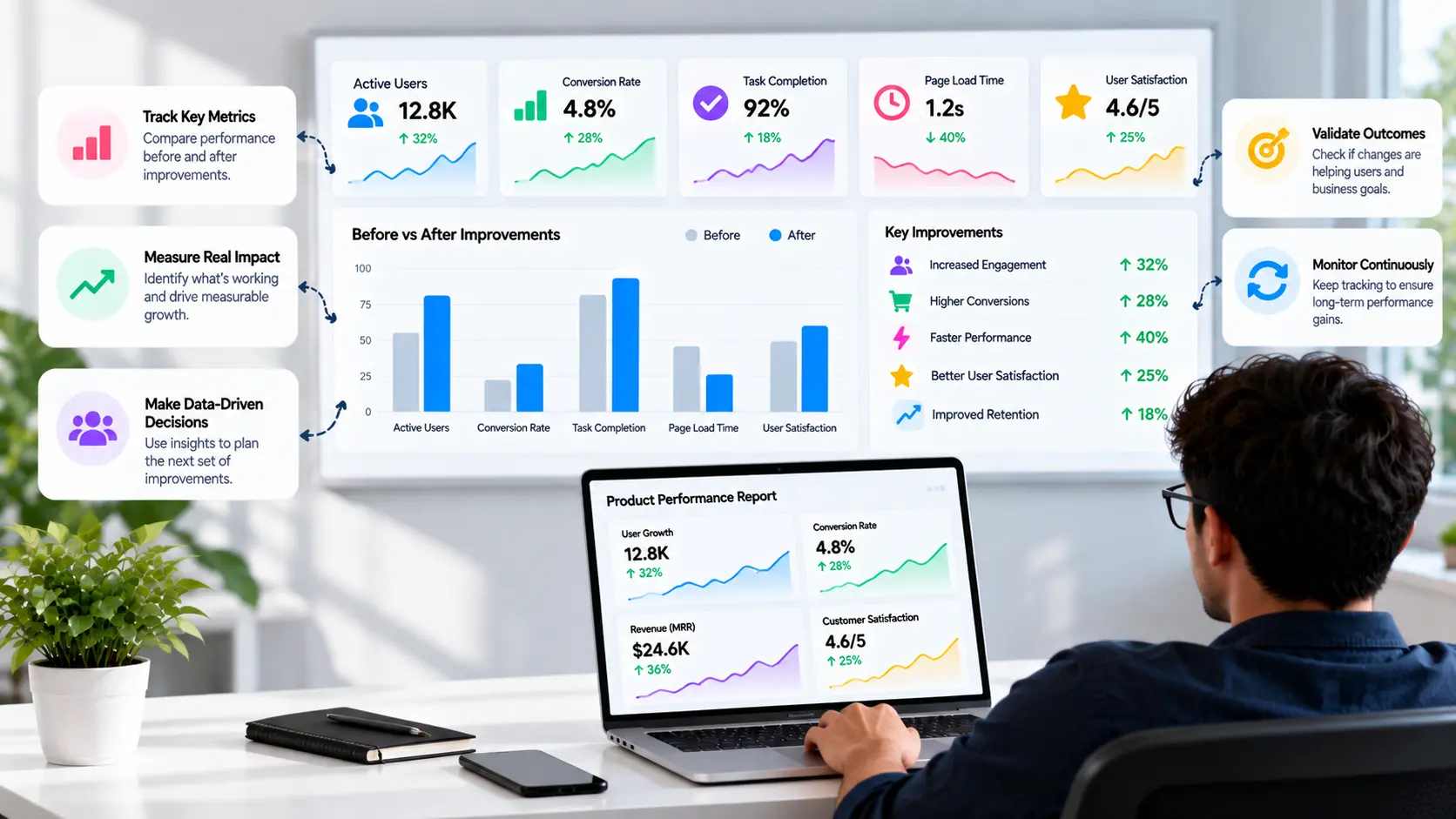
The process can begin by collecting insights, identifying opportunities, prioritizing improvements, implementing changes, measuring results, and feeding those learnings into the next development cycle.
- Collect insights: Gather information from analytics, users, support, and technical monitoring.
- Identify opportunities: Find problems and areas where improvement may create value.
- Prioritize work: Evaluate opportunities according to impact, urgency, and effort.
- Develop improvements: Design, build, and test the selected changes.
- Measure results: Review whether the improvement achieved its intended outcome.
- Repeat: Use new information to guide the next cycle of product development.
Common Product Optimization Mistakes to Avoid
Using data does not automatically result in better product decisions. The quality of the questions, interpretation, and development process matters just as much as the information being collected.
- Tracking too many metrics: Excessive data can make it harder to identify what actually matters.
- Focusing only on quantitative data: Numbers can reveal what is happening but may not explain why.
- Ignoring qualitative feedback: User conversations can reveal problems that analytics cannot fully explain.
- Reacting to individual requests: A single request should be evaluated against broader product needs and evidence.
- Optimizing for short-term metrics: A temporary improvement should not come at the expense of long-term product value.
- Making changes without measurement: Without evaluating outcomes, teams may repeat ineffective approaches.
- Ignoring technical performance: UX and technical performance are connected parts of the overall experience.
The goal is to create a balanced decision-making process where data, user feedback, product strategy, and technical knowledge work together.
Conclusion
Improving digital product performance is an ongoing process of learning, testing, and refinement. Analytics can reveal patterns in user behavior, while direct feedback can provide context around the problems users experience.
When these sources are combined, product teams can make more informed decisions about UX, performance, functionality, reliability, and future development.
The most effective approach is not to optimize everything at once. Instead, identify meaningful opportunities, prioritize them according to user and business impact, implement thoughtful improvements, and measure what happens next.
By continuously learning from data and users, digital products can remain useful, efficient, reliable, and aligned with changing expectations long after their initial launch.
Frequently Asked Questions
- What does digital product performance mean?
Digital product performance includes factors such as usability, responsiveness, reliability, engagement, technical performance, and the product's ability to help users achieve meaningful outcomes. - How can data improve a digital product?
Product data can reveal user behavior, performance problems, feature usage, drop-off points, and other patterns that help teams identify opportunities for improvement. - Why is user feedback important for product development?
User feedback provides direct insight into problems, expectations, frustrations, and opportunities that may not be visible through analytics alone. - What types of product data should businesses track?
Useful data depends on the product, but can include feature usage, important user actions, conversion events, task completion, errors, loading times, retention, and other product-specific metrics. - How do you prioritize product improvements?
Consider user impact, frequency, business value, technical risk, urgency, development effort, and the potential outcome of the improvement. - Should UX and technical performance be optimized separately?
They can be analyzed separately, but they are closely connected. Technical problems can create UX friction, while design decisions can also influence application performance. - How often should digital products be optimized?
Optimization should be an ongoing process rather than a fixed annual activity. The frequency should depend on product usage, user feedback, technical performance, business priorities, and the rate of change. - What is the best way to measure whether an improvement worked?
Define the expected outcome before making the change, measure relevant metrics before and after the release, and combine quantitative results with qualitative user feedback.

Insights | September, 2026
Designing Accessible Digital Products for Better User Experiences
Learn how thoughtful accessibility practices can make digital products easier to use, more inclusive, and more effective across different users, devices, and abilities.
Brandube

Insights | September, 2026
How to Plan a Successful Digital Product MVP Before Development
Discover how defining the right MVP scope, validating core ideas, and prioritizing essential features can help teams reduce complexity and build products with greater clarity.
Brandube

Insights | September, 2026
What Makes a Successful Mobile App: UX, Performance, and Functionality
Explore the essential factors behind successful mobile apps, from intuitive UX and responsive performance to useful functionality and consistent experiences.