Learn how to build meaningful digital products by connecting real user needs with thoughtful UX/UI design, product strategy, validation, and scalable development.

Table of Content
Overview Introduction Start with Real User Problems Conduct Meaningful User Research Turn Insights into Product Requirements Design the User Experience Validate Before Development Build with Scalability in Mind Common Mistakes to Avoid Conclusion Frequently Asked QuestionsOverview
Building a digital product is not simply about creating attractive interfaces or developing a collection of useful features. Successful digital products are built around people — their needs, expectations, behaviors, frustrations, and goals. A user-centered approach places these factors at the heart of product strategy, UX/UI design, development, and continuous improvement.
Whether you are building a website, mobile app, SaaS platform, web application, or custom software solution, understanding your users can help you make better product decisions from the beginning. Instead of relying on assumptions, teams can use research, testing, prototyping, and feedback to create experiences that are useful, intuitive, accessible, and aligned with real-world needs.
This guide explores the practical process of building a user-centered digital product from the ground up — from identifying the right problem and researching users to designing experiences, validating ideas, developing the product, and preparing it for long-term growth.
Introduction
Digital products have become an important part of how people work, communicate, shop, learn, manage information, and interact with businesses. As digital expectations continue to increase, users are less willing to tolerate confusing navigation, unnecessary complexity, slow performance, or experiences that do not solve their actual problems.
This makes user-centered digital product development more important than ever. A product should not begin with the question, “What features can we build?” It should begin with a more fundamental question: “What problem are we solving, and who are we solving it for?”
A user-centered process helps answer these questions before significant design and development resources are committed. It creates a clearer connection between user needs, business objectives, product requirements, visual design, technology, and measurable outcomes.
When these areas work together, product teams can create digital experiences that are not only visually engaging but also useful, understandable, reliable, and capable of evolving as user expectations and business requirements change.
Start with Real User Problems
The foundation of a user-centered digital product is a clearly defined problem. Before creating wireframes, choosing a technology stack, or writing development requirements, it is important to understand what users are actually trying to accomplish and where existing solutions are failing them.
A strong problem definition provides direction for the entire product development process. It helps teams distinguish between genuine user needs and assumptions that may not have enough evidence behind them.
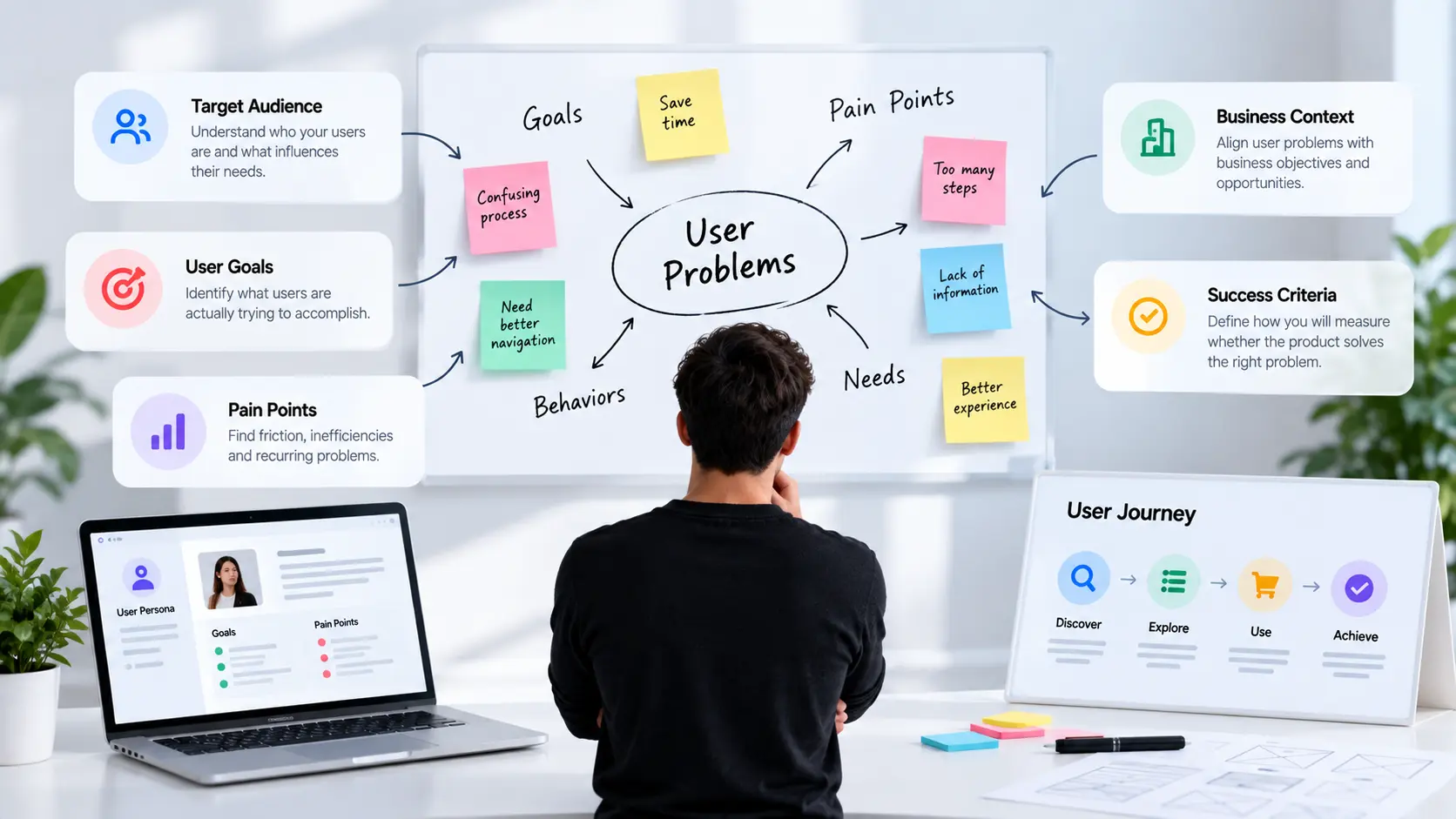
Start by identifying the target users, the context in which they use the product, their primary goals, and the challenges they experience. Consider what currently prevents them from achieving those goals efficiently. The answers can reveal opportunities for better product experiences.
- Define the target audience: Understand who the product is intended to serve and what characteristics influence their needs.
- Identify user goals: Focus on what users are actually trying to accomplish rather than simply listing desired features.
- Understand pain points: Identify friction, inefficiencies, confusion, and recurring problems in the current experience.
- Define the business context: Connect user problems with measurable business objectives and product opportunities.
- Establish success criteria: Determine how you will know whether the product is solving the intended problem.
A clearly defined problem becomes a reference point throughout the project. When new features or ideas are introduced, the team can evaluate whether they genuinely contribute to solving the original user problem.
Conduct Meaningful User Research
User research helps transform assumptions into evidence. It provides a deeper understanding of how people behave, what they expect, what frustrates them, and what influences their decisions. Strong research does not have to be complicated, but it should be relevant to the product decisions you need to make.
Depending on the product and stage of development, research can include user interviews, surveys, usability testing, analytics, customer feedback, competitor analysis, support conversations, and behavioral data. Each method can reveal a different part of the user experience.
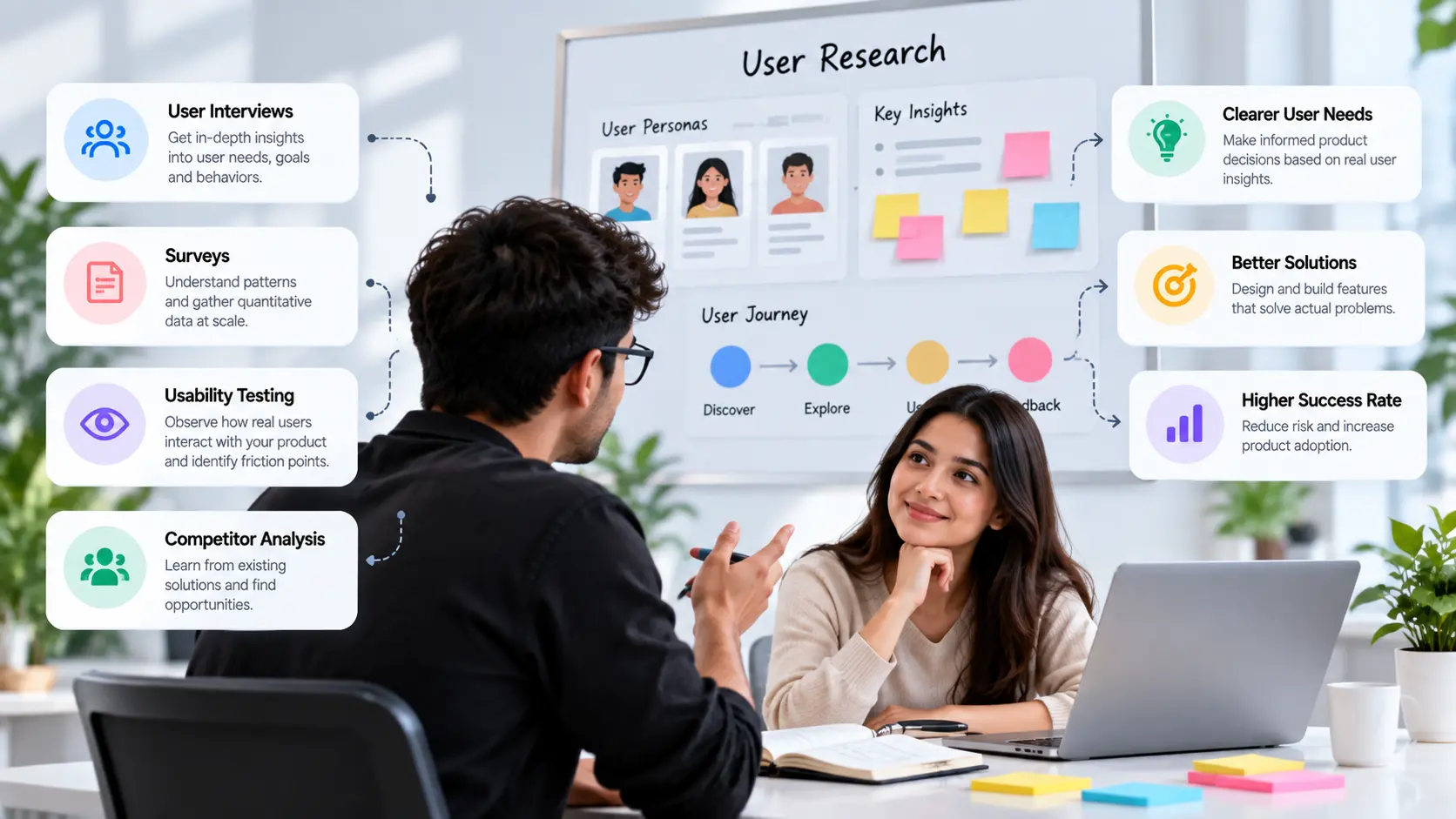
Qualitative research can help explain the reasons behind user behavior, while quantitative information can help identify patterns and measure their scale. Combining both perspectives creates a stronger foundation for product decisions.
- User interviews: Speak directly with users to understand their goals, challenges, expectations, and experiences.
- Usability testing: Observe users interacting with an experience to identify friction and usability problems.
- Surveys: Gather structured feedback from a larger group when broader input is required.
- Analytics: Examine behavioral data to understand how users navigate and interact with an existing product.
- Customer feedback: Review recurring questions, complaints, requests, and suggestions to uncover improvement opportunities.
- Competitive research: Study existing solutions to understand market expectations and identify areas for differentiation.
The objective is not to collect research for its own sake. Research should directly influence product decisions. Every meaningful insight should help the team understand what to build, why it matters, and how the experience should work.
Turn Insights into Product Requirements
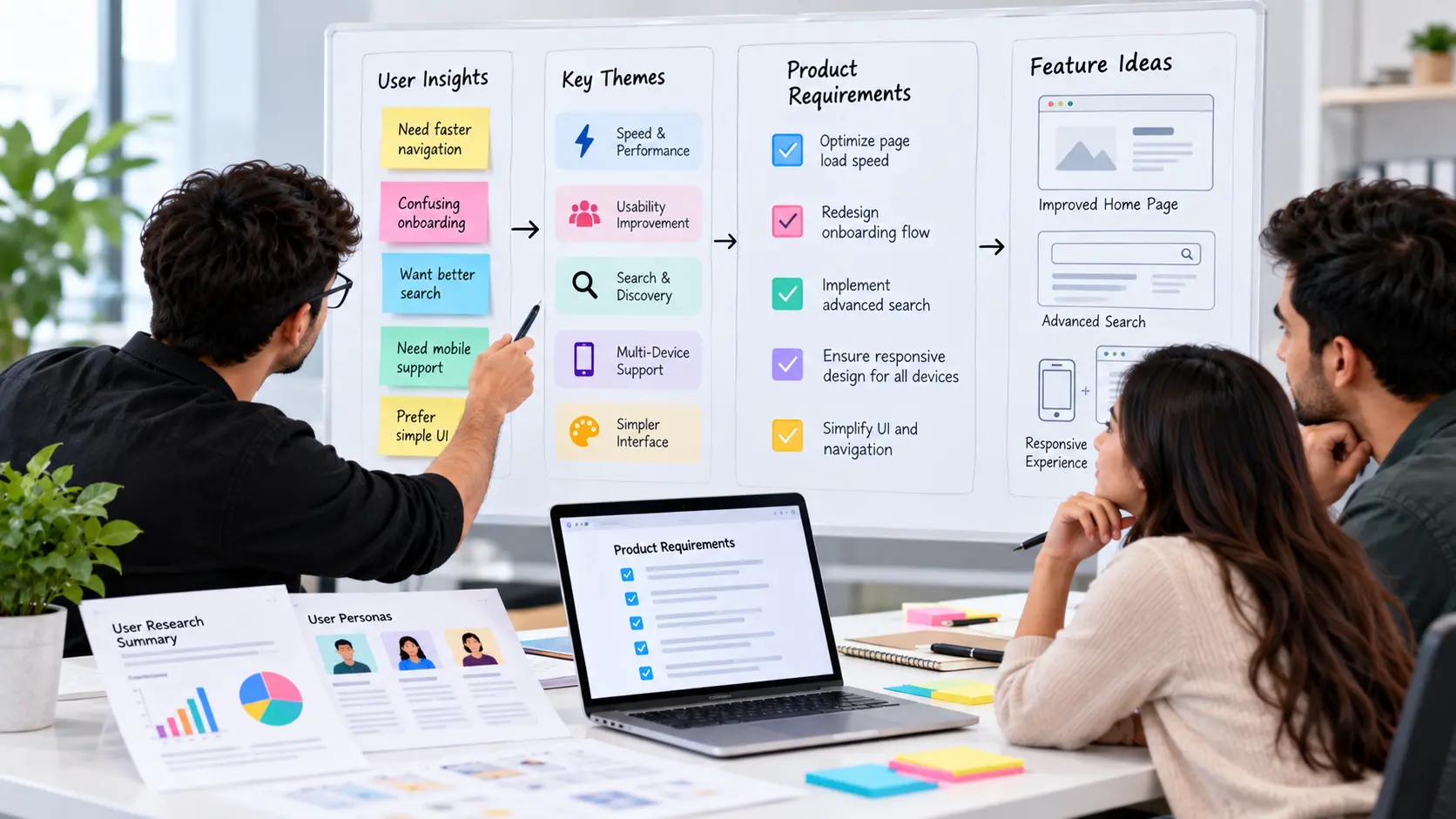
Research becomes valuable when it can be translated into clear product requirements. At this stage, user observations and business objectives need to become actionable decisions that designers, developers, and stakeholders can work with.
Start by identifying the most important user needs and organizing them according to their value and urgency. Not every user request should automatically become a feature. The product team needs to understand which problems have the greatest impact and which solutions are realistic within the available time, budget, and technical constraints.
Product requirements can then be organized into user stories, functional requirements, experience requirements, technical considerations, and measurable outcomes. This creates a common language between product strategy, UX/UI design, and software development.
- Prioritize user needs: Focus on problems that have the strongest impact on the target audience.
- Define core functionality: Establish the essential capabilities required to solve the primary problem.
- Separate must-have and nice-to-have features: Keep the initial product focused and manageable.
- Connect requirements to business goals: Ensure product functionality contributes to meaningful business outcomes.
- Document constraints: Consider technology, security, performance, budget, timeline, and operational requirements.
This step is particularly important when building an MVP. A focused product scope allows teams to validate the most important assumptions before investing heavily in secondary functionality.
Design the User Experience
Once the product problem and requirements are clear, UX/UI design turns those decisions into an experience users can understand and navigate. Good product design is not simply about making screens look attractive. It is about creating a logical relationship between user goals, information, interactions, content, and visual elements.
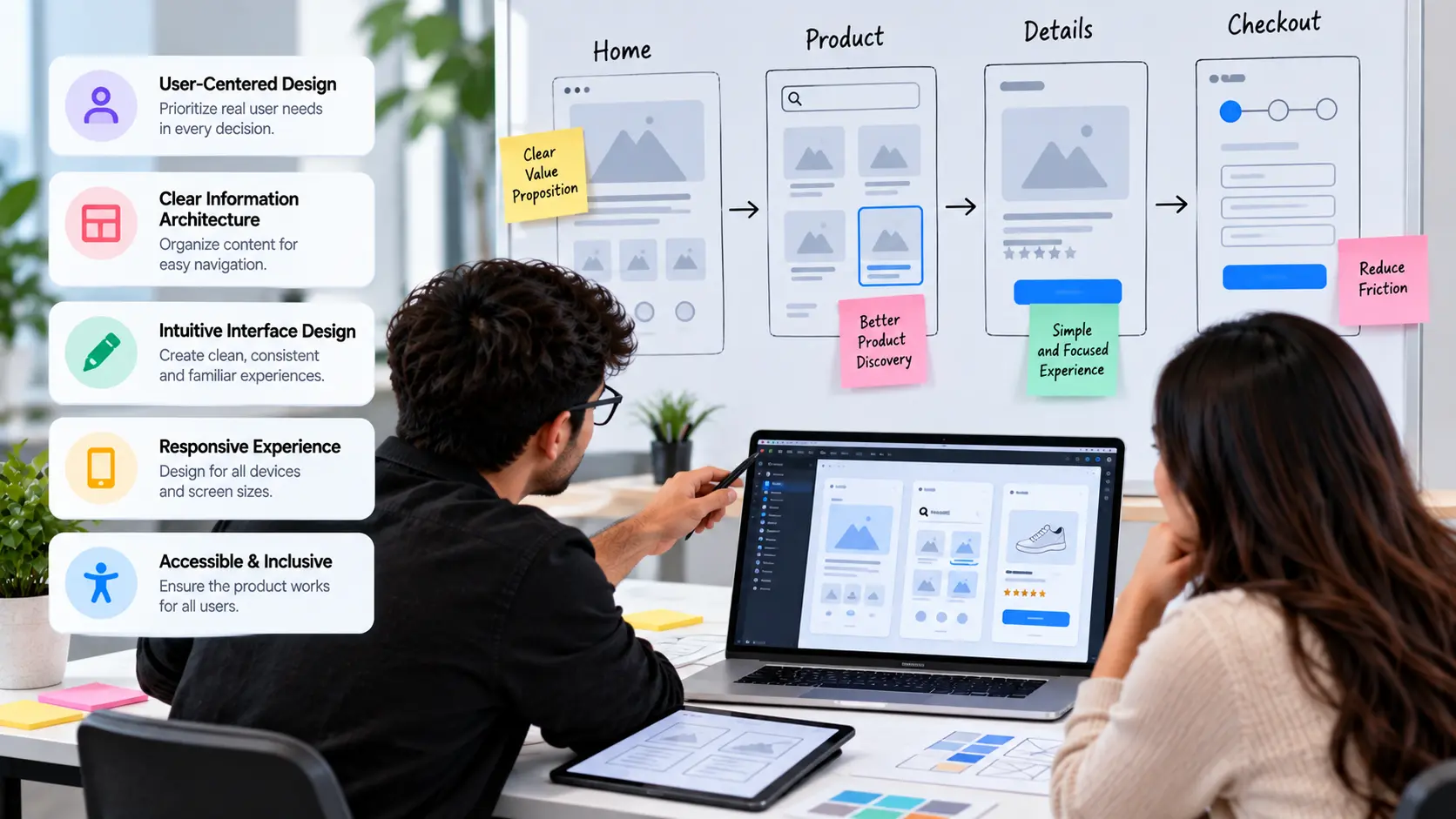
The UX process can begin with information architecture and user flows that explain how people move through the product. These structures can then be translated into wireframes, prototypes, and high-fidelity user interfaces.
A strong digital product experience should make important actions easy to understand while reducing unnecessary friction. Navigation should be predictable, information should be organized logically, and interfaces should provide clear feedback when users interact with them.
- Information architecture: Organize content and functionality so users can find what they need efficiently.
- User flows: Map the steps users take to complete important tasks and identify unnecessary friction.
- Wireframes: Establish structure and layout before investing heavily in visual details.
- UI design: Create clear, consistent interfaces using typography, spacing, color, components, and visual hierarchy.
- Responsive design: Ensure experiences work effectively across relevant screen sizes and devices.
- Accessibility: Consider inclusive interaction patterns so more users can successfully use the product.
Design should remain connected to research throughout this stage. When the interface is based on actual user needs rather than assumptions, it becomes easier to create an experience that feels natural and purposeful.
Validate Before Development
One of the most effective ways to reduce product uncertainty is to validate important decisions before committing significant development resources. A prototype can provide a realistic representation of the intended experience without requiring the entire product to be built.
Prototypes allow teams to test navigation, interactions, content structure, and key user flows. Users can be asked to complete realistic tasks while the team observes where they succeed, hesitate, become confused, or abandon the journey.
Feedback from these sessions can then be used to refine the experience before development begins. This iterative approach can prevent teams from spending time building functionality that later requires significant redesign.
- Test important user flows: Focus on the journeys that are critical to the product's purpose.
- Observe real behavior: Look at what users actually do rather than relying only on what they say.
- Identify friction: Find confusing navigation, unclear content, unnecessary steps, and interaction problems.
- Iterate quickly: Make improvements while changes are still relatively easy and inexpensive.
- Check technical feasibility: Work with development considerations early to identify potential constraints.
Validation is not about proving that every original design decision was correct. Its purpose is to discover what needs to change before those decisions become expensive to change in production.
Build with Scalability in Mind
A user-centered product also needs a reliable technical foundation. An excellent interface cannot compensate for poor performance, unreliable functionality, security weaknesses, or an architecture that cannot support future growth.
Development decisions should therefore consider both current requirements and reasonable future needs. This does not mean overengineering an early product. Instead, it means choosing an architecture and development approach that can evolve as the product gains users, functionality, integrations, and data.
- Performance: Optimize loading times, interactions, APIs, assets, and application behavior.
- Security: Protect user information, authentication systems, application data, and infrastructure.
- Maintainability: Build clean, understandable code and technical structures that can be maintained over time.
- Scalable architecture: Plan systems that can adapt as traffic, functionality, and business requirements increase.
- Integrations: Consider APIs, third-party services, payment systems, analytics, and other dependencies early.
- Deployment: Establish reliable processes for testing, releasing, monitoring, and maintaining the product.
User-centered development continues beyond the interface. A product that feels excellent but performs poorly can quickly lose user trust. Design and development therefore need to work together throughout the entire product lifecycle.
Common Mistakes to Avoid
Even well-intentioned product teams can lose focus during development. A user-centered approach requires discipline because there are often competing opinions, new feature requests, technical limitations, and changing business priorities.
- Designing from assumptions: Avoid making major decisions without understanding the people who will use the product.
- Adding too many features: Feature volume does not automatically create product value. Prioritize what solves important user problems.
- Skipping user testing: Internal opinions cannot replace observing real users interacting with the product.
- Treating UX/UI as decoration: Product design should influence structure, functionality, navigation, and interaction — not only visual appearance.
- Ignoring technical scalability: Consider performance, security, maintainability, and future requirements during development.
- Failing to measure results: Without meaningful metrics and feedback, it becomes difficult to understand whether the product is improving.
- Stopping after launch: Digital products need ongoing development, optimization, maintenance, and refinement as users and business needs evolve.
The strongest product teams treat these challenges as part of an ongoing learning process. Instead of expecting the first version to be perfect, they create a system for learning, improving, measuring, and adapting.
Conclusion
Building a user-centered digital product from the ground up requires more than strong design or reliable development. It requires a connected process that begins with understanding real user problems and continues through research, product strategy, UX/UI design, prototyping, validation, development, measurement, and ongoing improvement.
The goal is not simply to launch a digital product. The goal is to create an experience that genuinely helps users accomplish something while supporting the objectives of the business behind it.
When user needs guide product decisions, teams can create clearer experiences, prioritize development more effectively, reduce unnecessary complexity, and build products that are better prepared to evolve. A user-centered mindset turns product development into an ongoing process of learning and improvement rather than a one-time launch.
Start with the problem. Understand the user. Design with purpose. Validate before investing heavily. Build for reliability and growth. Then continue learning from real usage. That is the foundation for creating digital products that remain useful, relevant, and valuable over time.
Frequently Asked Questions
- Why is user-centered design important for digital products?
User-centered design helps ensure that a digital product is built around real user needs, behaviors, expectations, and problems rather than assumptions. This can lead to clearer experiences, better usability, and more meaningful product value. - What is the first step in building a user-centered digital product?
The first step is to clearly understand the problem you are trying to solve and the people experiencing it. Defining the target audience, user goals, pain points, and desired outcomes creates a stronger foundation for research and product strategy. - How does user research influence UX/UI design?
User research provides insights into how people behave, what they expect, and where they experience difficulties. These insights can influence information architecture, user flows, wireframes, interface design, content, and interaction patterns. - Should product design happen before development?
UX/UI design and development should work closely together, but key user flows, requirements, and design decisions should generally be explored and validated before significant development investment. This helps identify usability and product issues earlier. - What methods can be used to validate a digital product?
Common validation methods include prototypes, usability testing, user interviews, surveys, analytics, customer feedback, and early product releases. The appropriate method depends on the product stage and the assumptions that need to be tested. - How should features be prioritized for a digital product?
Features should be prioritized according to user value, business importance, technical feasibility, risk, and available resources. Focusing on the most important problems can help teams avoid unnecessary complexity and create a more focused product. - How does a user-centered approach benefit a business?
A user-centered approach can help businesses create products that are more relevant to their target audience, reduce avoidable design and development rework, improve usability, and create stronger opportunities for engagement and long-term product growth. - Does user-centered product development continue after launch?
Yes. Launching a product is the beginning of an ongoing learning process. Analytics, customer feedback, usability observations, performance data, and changing business requirements can all inform future improvements, new features, and product development.

Insights | September, 2026
The Complete Guide to UX/UI Design for Modern Digital Products
Explore the essential principles of UX/UI design that help create intuitive interfaces, meaningful interactions, and engaging digital product experiences.
Brandube

Insights | September, 2026
How User Research Shapes Better Digital Product Experiences
Discover how meaningful user research reveals behaviors, expectations, and pain points that lead to more relevant and effective digital experiences.
Brandube

Insights | September, 2026
From Wireframes to Prototypes: A Practical Guide to Product Design
Learn how wireframes and prototypes transform early product ideas into clear, testable experiences while reducing design and development uncertainty.